
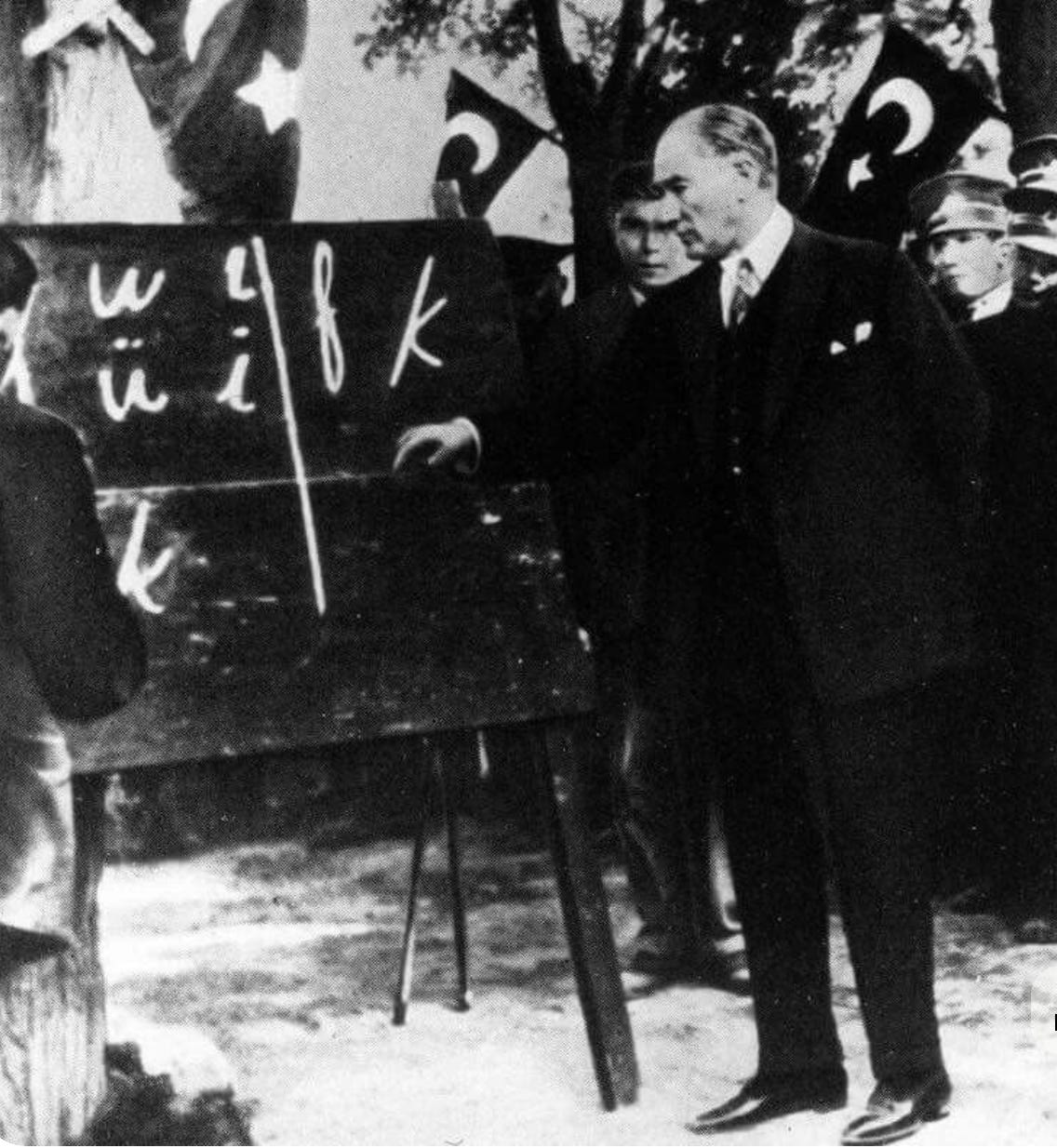
The story of modern Türkiye begins, in many ways, with a piece of chalk.
In the autumn of 1928, Mustafa Kemal Atatürk stood before a blackboard, somewhere in Anatolia, and began to draw letters. They were simple, clean, and unfamiliar. A crowd gathered: farmers, shopkeepers, soldiers, men in fezzes, women in headscarves. He spoke to them not as a distant statesman but as a teacher. These, he said, were the new letters of the nation. With them, a people would learn to read, to write, and to belong to a new age.
It was an audacious moment. In a matter of months, the script of an entire civilization would be abandoned. The old letters, which had served the Ottoman Empire for centuries, would vanish from daily life. In their place would stand a Roman alphabet. It would be modern, phonetic, and Western in appearance. It was not simply a reform. It was a rupture.
To understand what happened in Türkiye in 1928 is to understand how language can become a battlefield, how letters can be tools of power, and how a nation can attempt to rewrite not only its future, but its past.
The Burden of an Inherited Script
For centuries, Ottoman Turkish had been written in a script derived from Arabic. It was elegant on the page, flowing and calligraphic, rich with the prestige of religion and empire. But it was also, in practical terms, deeply ill-suited to the Turkish language.
Turkish is a language of clarity. It is agglutinative, meaning that words grow through the addition of suffixes. Meaning unfolds step by step, each syllable carrying grammatical weight. Crucially, Turkish depends on vowels; precise, ordered, harmonious vowels that shape both sound and sense.
The Arabic script, by contrast, was designed for a different linguistic world. It was consonant-heavy, with vowels often omitted or only partially indicated. For Arabic, this posed little difficulty; the structure of the language allowed readers to infer meaning. For Turkish, it created ambiguity. Words could be read in multiple ways. Learning to read required not only memorization but experience, intuition, and often guidance from those already initiated into the written tradition.
The result was predictable. Literacy remained low. By the early 20th century, only a small fraction of the population, perhaps 10 percent, could read and write with confidence. Literacy was concentrated among bureaucrats, religious scholars, and urban elites. The written word belonged to the state and the mosque, not to the village.
Language, in this sense, reinforced hierarchy. To read Ottoman Turkish was to enter a closed world. It was a world of administrative jargon, Persian poetic forms, and Arabic religious vocabulary. The spoken language of ordinary people diverged sharply from what was written. There was, in effect, a gulf between the tongue of daily life and the language of authority.
This was the inheritance that confronted Atatürk after the collapse of the empire.
Empire Falls, Nation Rises
The end of the World War I shattered the Ottoman order. Defeat brought occupation, partition, and humiliation. Yet from this collapse emerged a new struggle, the Turkish War of Independence, which would give birth to a republic.
In 1923, the Republic of Türkiye was proclaimed. It was not merely a change of government. It was an attempt to construct a new identity from the ruins of an imperial past.
Atatürk and his allies believed that survival depended on transformation. The institutions of the old empire, its legal codes, its educational systems, its religious authority, were seen as obstacles to progress. Reform would have to be sweeping, deliberate, and, above all, visible.
Clothing changed. The fez was discouraged, Western hats appeared. Legal systems were rewritten along European lines. Religious institutions were brought under state control or dismantled. The caliphate itself was abolished.
Yet beneath all these reforms lay a deeper question: what language would this new nation speak, and how would it write it?
The Decision to Change the Alphabet
The move toward alphabet reform did not come out of nowhere. Intellectuals in the late Ottoman period had already debated the limitations of the Arabic script. Some proposed modifications; others suggested more radical change. But such discussions remained theoretical, constrained by tradition and the political realities of empire.
In the republic, constraints loosened.
In 1928, the Grand National Assembly passed the Law on the Adoption and Implementation of the Turkish Alphabet. It was a short law with immense consequences. The Arabic script would be replaced by a new alphabet based on Latin letters.
A commission of linguists and officials designed the system. It would contain 29 letters, carefully adapted to Turkish phonology. New characters (ç, ş, ğ, ö, ü) were introduced to capture sounds absent in standard Latin scripts. Each letter corresponded closely to a sound. Reading and writing would become, in principle, straightforward.
The reform was not gradual. It was immediate.
Within months, civil servants were required to learn the new script. Newspapers switched. Public signage changed. The old letters disappeared from official use. The state moved with speed, and with purpose.
A Nation Learns to Read
The reform was accompanied by an unprecedented educational campaign. The Millet Mektepleri (“People’s Schools”) were established across the country. Adults who had never attended school sat beside children. Teachers traveled to remote villages. Blackboards appeared in public squares.
Atatürk himself took part. His image, chalk in hand, explaining letters to citizens, became iconic. It was theater, but it was also pedagogy. The leader of the nation was teaching his people how to write.
There was urgency in this effort. The new alphabet was not simply an option; it was a requirement. To function in the modern state, meaning to read laws, to sign documents, to engage with public life, one had to learn the new script.
For many, this was liberating. The new alphabet was easier to master. Words could be sounded out. Writing became accessible. Literacy, once confined to elites, began to spread.
But for others, it was disorienting. Those who had spent years mastering the old script found themselves suddenly illiterate. Books they had once read with ease became indecipherable. A lifetime of learning seemed to vanish overnight.
This was the cost of speed.
Language as a Tool of Power
The alphabet reform cannot be understood as a purely educational measure. It was, at its core, political.
By changing the script, the state altered the relationship between citizens and their past. Ottoman archives, legal documents, poetry, and correspondence, all remained in the old script. Access to them now required specialized training.
This created a break in historical continuity. The average citizen could no longer read the writings of their grandparents, let alone earlier generations. The past became mediated and filtered through scholars, translators, and institutions.
For the state, this had advantages. It allowed for a controlled reinterpretation of history. Narratives could be shaped, emphasized, or downplayed. A new national story, one centered on Turkish identity rather than imperial or Islamic heritage, could take root.
Language reform also extended beyond script. The vocabulary of Turkish was systematically altered. Words of Arabic and Persian origin were replaced with alternatives drawn from Turkic roots or newly coined terms. The aim was to “purify” the language, to align it with a national identity distinct from the cosmopolitanism of the Ottoman world.
This was nation-building through language.
Breaking with the Islamic World
The adoption of the Latin alphabet carried symbolic weight. It marked a clear departure from the cultural sphere associated with Arabic script—the Islamic world.
For centuries, the Arabic script had been more than a writing system. It was tied to religion, to the Qur’an, to a shared intellectual and cultural heritage stretching across regions and centuries. To abandon it was to signal a shift in orientation.
Atatürk’s reforms aimed to create a secular state. Religion would no longer define political authority. By adopting a new script, the republic reinforced this separation. The sacred texts of Islam remained in Arabic, but they now stood apart from the language of everyday life.
This did not sever religious belief. But it did alter its place within public culture. The visual and linguistic markers of Islamic identity became less central to the state’s self-presentation.
Turning Toward the West
If the reform marked a departure from one sphere, it also signaled an approach toward another.
The Latin alphabet was associated with Europe. Its adoption aligned Türkiye visually and culturally with Western nations. It suggested openness to new ideas, new systems, and new forms of knowledge.
This alignment was not merely symbolic. It had practical implications. Learning European languages became easier. Scientific and technical texts could be more readily accessed. The barriers between Türkiye and Western intellectual life were lowered.
For Atatürk, this mattered. He saw modernization as inseparable from engagement with the West. The alphabet reform was one piece of a broader strategy to reposition the nation.
Reactions Beyond Türkiye
The reform did not go unnoticed.
Across the Middle East, intellectuals watched with interest and concern. Some admired the boldness of the move and its apparent success in raising literacy. Others saw it as a betrayal of shared cultural heritage.
In Iran, under Reza Shah, similar debates emerged. Reformers considered script change but ultimately retained the Persian script derived from Arabic, wary of the disruption it might cause and the resistance it would provoke.
In Arab societies, discussions of script reform also occurred, especially in Lebanon. But the connection between Arabic language and Islamic identity proved too strong to overcome, even as the Arab world began its long experimentation with secular nationalism. The Turkish example served as both inspiration and warning. It demonstrated what was possible and what might be lost.
The Gains of Reform
Over time, the practical benefits of the new alphabet became clear.
Literacy rates rose steadily throughout the 20th century. Education expanded. The written word became accessible to broader segments of society. Newspapers, books, and official documents reached audiences that had once been excluded.
This had economic consequences. A more literate population could participate more effectively in administration, industry, and commerce. Communication improved. The state could function with greater efficiency.
The reform also contributed to the development of a modern public sphere. Citizens could engage with ideas, debates, and information in ways that had previously been limited.
In these respects, the alphabet reform achieved its goals.
The Cost of Rupture
Yet the gains came with losses.
The most significant was the break with the Ottoman past. Historical documents became inaccessible to the general public. Literature written in the old script required translation or specialized study.
This created a dependency on experts. The interpretation of history became, to a degree, centralized. Ordinary citizens were distanced from their own cultural heritage.
There was also a subtler loss, and that was the erosion of linguistic continuity. Words disappeared, expressions changed, and the language of earlier generations faded from common use.
For some, this was a necessary sacrifice, but for others it was a severing of roots.
Memory and Identity
Today, the legacy of the alphabet reform remains contested.
For supporters, it stands as a triumph of rational reform. It is evidence that deliberate, state-led change can transform society. It is associated with progress, education, and national cohesion.
For critics, it represents a rupture, an imposed break with history that narrowed cultural memory. They argue that it limited access to the richness of the Ottoman past and simplified a complex linguistic heritage.
Both views contain truth.
The reform did not simply change how Turks wrote. It changed how they remembered, how they learned, and how they understood themselves.
A Bridge Between Worlds
Türkiye today is often described as a bridge between East and West, past and present, and tradition and modernity. The alphabet reform is central to this reality.
By adopting the Latin script, Türkiye distinguished itself from its neighbors. It carved out a unique cultural position. It became, in some ways, more legible to Europe and less so to the regions with which it had once been most closely connected, and had dominated for over 400 years.
This duality continues to shape its politics, its culture, and its place in the world.
The Chalk and the Blackboard
It is easy, in retrospect, to view the reform as inevitable. It was not.
It required political will, administrative capacity, and a willingness to accept disruption. It depended on a vision of the future that justified the costs of change.
Atatürk understood the power of symbols. The image of a leader teaching letters was not accidental. It conveyed a message: that the nation was being remade and that knowledge was being democratized.
The Weight of Letters
Language is never neutral. It carries meaning, history, identity, and power. In 1928, Türkiye altered all three.
By replacing the Arabic script with a Romanized alphabet, the republic reshaped its cultural trajectory. It expanded literacy and facilitated modernization. It aligned itself with the West and distanced itself from its Ottoman-Islamic heritage.
The reform was both an opening and a closing. It opened the door to education, communication, and global engagement. It closed, or at least narrowed, the door to a vast written past.
Nearly a century later, the consequences endure. The letters that Atatürk drew on the blackboard are now taken for granted. They are the medium through which millions read, write, and think.
Yet behind them lies a story of ambition, rupture, the genuine power of the written word, and the enduring tension between past and future.