
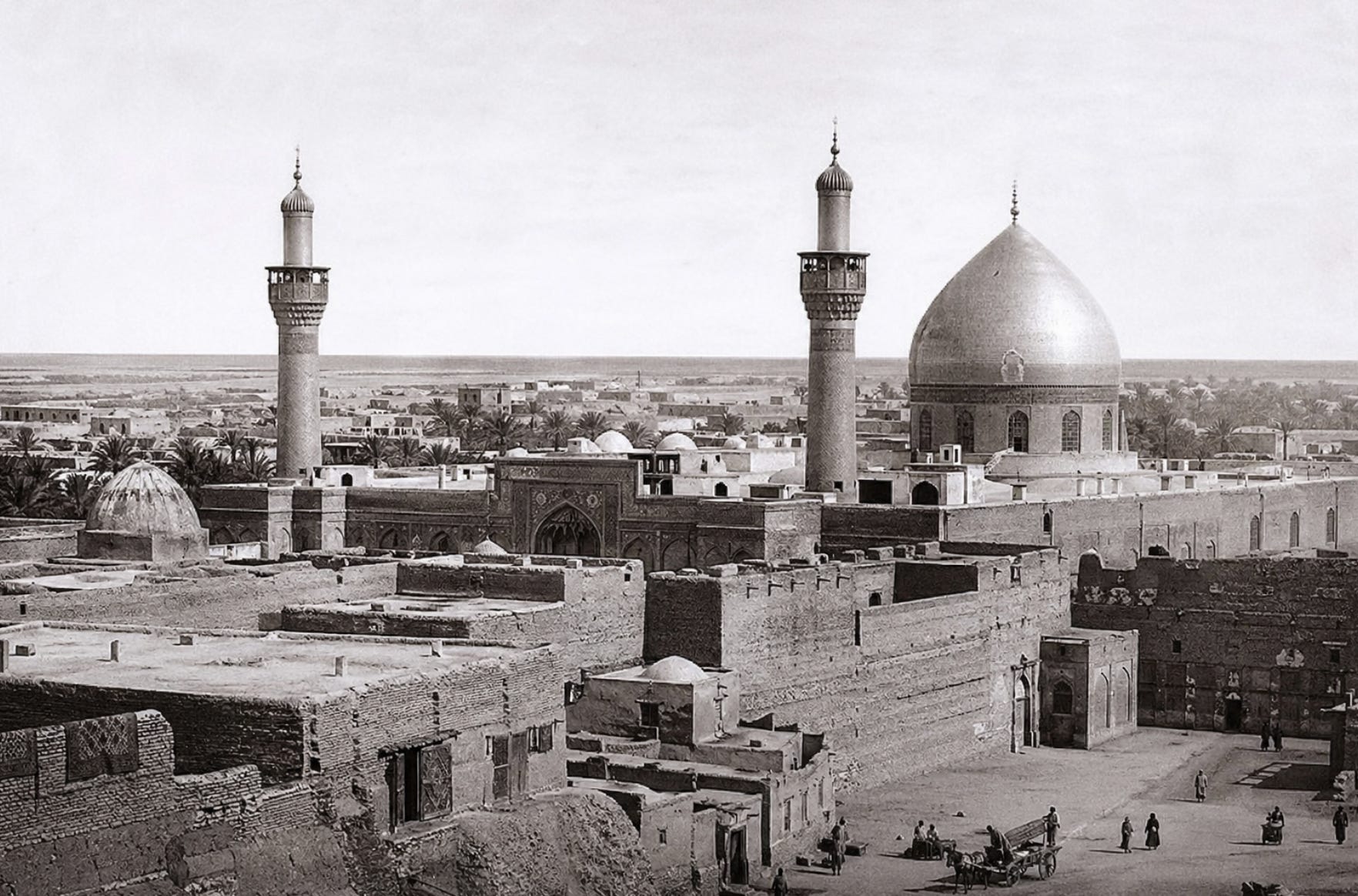
I. Introduction: The City at the Center of the Shi’i World
Najaf is not a normal city. It is organized around a tomb, the shrine of Imam Ali ibn Abi Talib, the first Imam of Twelver Shi’ism, and that fact has shaped everything about how power is accumulated, transmitted, and contested there. For more than a millennium, scholars, pilgrims, merchants, and donors have flowed through the city, leaving behind seminaries, endowments, reputations, and lineages. The result is a political and social order unlike any other in the Arab world: one in which religious authority, family prestige, transnational networks, and, increasingly in the modern period, armed factions and party organizations intersect and compete.
The temptation is to describe Najaf as ruled by a “clerical aristocracy”, a small set of great families who have controlled the city across generations. There is something to this image, and certain names do recur across centuries: al-Sadr, al-Hakim, al-Khoei, Bahr al-Ulum, Kashif al-Ghita, al-Shirazi. But the image misleads more than it illuminates if taken at face value. The Hawza, Najaf’s vast complex of religious seminaries, is formally a scholarly ecosystem rather than a hereditary church, and scholarly authority in Shi’i Islam is earned through learning and recognized by followers rather than simply passed from father to son. In practice, however, families that combine deep lineage, sustained scholarship, marriage alliances, property, endowments, a following of students, and access to transnational donor networks have enjoyed durable advantages across generations. It is the combination that matters, not any single element in isolation.
A second corrective is equally important. Many of the families treated today as the great “Najafi” houses did not originate in Najaf. The city became a magnet that drew scholarly lineages from Iranian cities, from Jabal Amil in what is now south Lebanon, from Bahrain and the Gulf littoral, and, by the nineteenth century, from India and the broader Indian Ocean Shi’i world. Najaf and the other great shrine city of Karbala are best understood not as sealed local institutions but as nodes in a transnational clerical field that has long connected Iraq to Iran, the Levant, the Gulf, South Asia, and, in the modern era, diaspora communities across Europe and North America.
This essay traces the history, present structure, and likely future of the main clerical families and networks centered on Najaf. It is organized in three broad movements. The first examines the pre-modern world before 1900, when these were primarily scholarly-notable houses rather than modern political dynasties. The second traces the transformation of the twentieth century, when party politics, exile, Ba’thist repression, and post-2003 state-building reshaped the families’ roles entirely. The third surveys the present landscape: the distinct positions of the Sadrs, Hakims, the Khoei-Sistani axis, and the older notable houses, and considers what is at stake in the coming succession struggle at the top of Najaf’s clerical hierarchy.
II. Origins: The Pre-Modern Clerical City
The Rise of Najaf as a Center of Learning
Although the shrine of Imam Ali has been a pilgrimage destination since the early Islamic period, Najaf became the dominant pole of Shi’i scholarship on a sustained basis only gradually, and its consolidation at the top of the hierarchy of learning belongs above all to the Qajar period of the eighteenth and nineteenth centuries. The city had been home to scholarship since the great jurist Shaykh al-Tusi settled there in the eleventh century, but for long stretches Karbala could rival or eclipse it, and neither city maintained its dominance without interruption.
What made Najaf rise and stay risen in the nineteenth century was a combination of political stabilization, growing infrastructure, and above all the enormous flows of money and people that accompanied the expansion of Shi’i patronage networks.
Qajar Iran was the single most important patron. Iranian rulers, merchants, and pilgrims channeled endowment funds, donations, and religious taxes into Najaf’s seminaries, shrines, and charitable institutions on a scale that transformed the city’s material conditions.
India was the second great patron. The Oudh Bequest (funds sent from the court of Awadh to Najaf and Karbala in the second half of the nineteenth century) supported mujtahids, students, shrine staff, and the poor, and became, as British colonial administrators quickly recognized, an important lever of potential political influence. More broadly, the Indian Ocean Shi’i world, including merchant communities stretching from the Persian Gulf to Bombay and beyond, channeled endowments, hostels, and service infrastructure into the shrine cities. By the late nineteenth century, the major scholarly families of Najaf were operating in a genuinely global network bridging the British and Ottoman empires.
The result was that with generous patronage from both Shi’i Indians and Qajar rulers, Najaf’s fortunes improved sharply, and it came to serve as the leading center of learning for much of the Twelver Shi’i world.
This transnational financial base was institutionally decisive. Because the ulama of Najaf depended on donors, on the khums (a fifth of surplus income that Shi’i Muslims owe to the religious authorities), on charitable gifts, on waqf endowments, rather than on a salaried state-religious institution structure, they developed deep ties to merchants, landed patrons, and wealthy communities across borders. This gave leading families real autonomy from local rulers, but it also tied them into the patronage circuits of Iran, India, and the Gulf. A scholar who attracted students and donors from across the Shi’i world acquired a kind of authority that was at once religious, social, and financial.
The Old Najafi Houses: Bahr al-Ulum and Kashif al-Ghita
Among the houses that can be traced with genuine depth into the pre-modern period, two stand out most clearly: the Bahr al-Ulum family and the Kashif al-Ghita family. They represent slightly different types of clerical authority, but both were deeply embedded in Najaf’s scholarly and urban life before the age of modern politics.
The Bahr al-Ulum family’s great pre-modern figure was Sayyid Muhammad Mahdi Bahr al-Ulum, who died in 1797. His formation was typical of the transregional scholarly world: trained first in Karbala by his father and then by the celebrated Bahrani jurist Shaykh Yusuf al-Bahrani before settling in Najaf, he became a scholar of wide influence exercised through the many students he trained in both Iraq and Iran. The family’s identity was inseparable from the Tabataba’i sayyid lineage and from its connections to the broader Majlisi scholarly world. In other words, it was embedded in the elite sayyid networks that linked Najaf, Karbala, Isfahan, and other centers of Shi’i learning. Its power flowed through teaching circles, the granting of ijazat (formal scholarly certifications), legal authority, and the social networks that students carried with them when they dispersed to other cities and regions.
The Bahr al-Ulum story is already a corrective to any simple notion of “Najafi” origins. The family was formed through a Karbala-Najaf-Iran scholarly circuit rather than through purely local roots, and its strength in Najaf rested partly on its connections to the wider transregional Shi’i establishment. In older shrine-city society, a family of this type also gained standing through mediation, charitable distribution, and its place in the urban hierarchy around the shrine. It was a kind of soft authority over pilgrims, students, urban notables, and supplicants that translated into real social power.
The Kashif al-Ghita family was, by contrast, more locally rooted in Iraqi Arab and Najafi society. The family’s key early modern figure was Shaykh Ja’far Kashif al-Ghita, who died in 1813, a major jurist who contributed to Najaf’s standing in Shi’i jurisprudence and who left behind a tradition of scholarship and family-maintained madrasas and libraries. The Kashif al-Ghita family allied itself with the Zukurt, one of the main urban factions in Najaf’s local political order. Pre-twentieth-century clerical families were not floating above urban politics; they were embedded in local social orders and patronage struggles, where scholarship, family prestige, and municipal faction reinforced and enabled one another.
A house like Kashif al-Ghita derived power from its control of learning circles, its marriage alliances, its urban followers, and its management of relations with Ottoman governors, tribal leaders, and merchant patrons. The Ottomans governed the shrine cities largely through indirect rule, balancing families, factions, and tax arrangements rather than imposing tight administrative control. In that environment, a great clerical house was also a kind of urban machine, a provider of mediation, legitimacy, and patronage, but one whose idiom was religious scholarship rather than modern ideology.
The Later Arrivals: Hakim, Sadr, and Shirazi Roots
The families that became most politically prominent in the twentieth century have more ambiguous pre-modern histories. The Hakim family is described in the broader scholarly literature as one of Najaf’s renowned families of religious scholars with roots across multiple generations, and its lineage connects it to the wider sayyid-scholarly world, with family traditions linking it to Isfahan and Najaf. But the family’s major public prominence belongs entirely to the twentieth century, and it is more accurate to describe the pre-modern Hakims as part of the long-standing sayyid-scholarly layer of Najaf than as a dominant clerical dynasty in their own right.
The Sadr family is an even clearer case of later arrival through Iranian migration. The modern Sadr line is associated with Sayyid Isma’il al-Sadr, who came from Isfahan and studied in both Najaf and Samarra in the late nineteenth century. He was a figure who marks the transition into the family’s modern prominence. The Sadrs are a good illustration of the broader pattern by which Iranian sayyid scholarly families entered the Iraqi shrine-city system, became “Najafi” through residence, study, marriage, and the accumulation of disciples and donors, and eventually became central figures in the city’s clerical life. They were not, in any deep sense, an “ancient Najafi clan.”
The Shirazi network had its pre-modern center not in Najaf but in Iran and Samarra, and its greatest nineteenth-century figure, Mirza Hasan Shirazi, who died in 1895, was a jurist whose authority extended across the Shi’i world and who demonstrated with striking clarity how a single marja’ could mobilize transnational religious authority with political consequences: his famous fatwa against tobacco in 1891, issued in response to a British concession granted by the Qajar court, helped generate a mass protest movement across Iran. The Shirazi school was thus, from its origins, more activist and more willing to leverage religious authority in direct political confrontation than the quietist traditions associated with the old Najafi scholarly establishment.
The Khoei family barely enters the pre-modern picture at all: Abu al-Qasim al-Khoei was born in 1899 in Khoy in Iranian Azerbaijan, and his importance belongs almost entirely to the twentieth century.
The Shape of Pre-Modern Power
What united all of these families across their differences of origin and style was that they were, before the twentieth century, primarily scholarly-notable houses. Their political arenas were those of the pre-modern Islamic city and empire: relations with Ottoman governors, disputes over tax and waqf resources, management of pilgrim flows, mediation among tribes, towns, and merchant communities, and influence over transborder Shi’ite populations who looked to Najaf for legal guidance and religious leadership. Their networks were built from wakils (personal representatives), students, donors, allied merchants, and linked notables spread across the Shi’i world from the Gulf to India.
In that older world, Najaf’s ulama community was notably multi-ethnic: Iranians, Iraqi Arabs, Lebanese and Jabal Amil Arabs, Gulf Arabs, and Indians coexisted in the seminaries and shrine neighborhoods, and scholarly authority transcended ethnic and national boundaries because the Shi’i community itself transcended them. The circulation of scholars between Jabal Amil, Bahrain, Iraq, and Iran was a structural feature of pre-modern Shi’i learned culture, not an anomaly. Najaf was the most prestigious node in that circulation, but it was a node in a network, not a sealed national institution.
III. The Transformation: The Twentieth Century
From Scholarly Houses to Political Dynasties
The shift from scholarly-notable house to modern political dynasty was not sudden, but it accelerated dramatically across the twentieth century under the pressure of three large forces: the dissolution of Ottoman order and the creation of the modern Iraqi state; the spread of ideological politics and organized Islamism; and the Ba’athist dictatorship and its aftermath.
The creation of Iraq as a modern state in the aftermath of the First World War placed Najaf’s clerical families in a new and often uncomfortable relationship with a centralized, increasingly nationalist secular government. The 1920 Iraqi Revolt against British Mandatory rule involved the Najaf ulama significantly, and the subsequent consolidation of the Hashemite monarchy and then the Ba’athist state progressively narrowed the space for clerical political independence. Under Ba’ath rule, and especially after the catastrophic crackdowns that followed the 1968 Ba’thist seizure of power and intensified after 1979, Najaf’s clerical families faced a choice: accommodation, quietism, or resistance; and, for those who chose resistance, exile.
The intellectual revolution that preceded and accompanied these pressures was the work above all of Muhammad Baqir al-Sadr, the most important Shi’i political theorist of the twentieth century. Born in 1935, educated in Najaf’s seminaries, and deeply engaged with the secular ideological currents of Marxism, nationalism, and Ba’athism that were competing for the loyalty of Iraq’s educated Shi’a, Muhammad Baqir al-Sadr developed a systematic Shi’i political philosophy and helped found the Da’wa Party, one of the first organized Islamist political parties in Iraq. His execution by Saddam Hussein in 1980, together with his sister Bint al-Huda, made him a martyr whose intellectual and symbolic legacy shaped Shi’i Islamist politics for decades afterward.
The Sadr family’s story thus splits into two distinct trajectories. On one side, the intellectual and martyrological legacy of Muhammad Baqir al-Sadr became the foundation of a transnational Shi’i Islamist political culture, influencing not only Iraqi politics but also the intellectual formation of clerics and activists across the Shi’i world. On the other side, his cousin Musa al-Sadr (who had moved to Lebanon in the 1960s) built an independent clerical and political career among Lebanon’s long-marginalized Shi’i community, founding the Amal movement and becoming one of the most important figures in modern Lebanese politics before his mysterious disappearance in Libya in 1978. The family’s dispersal across Iraq, Lebanon, and Iran illustrates the transnational character of great Shi’i clerical houses, and the way a single lineage can simultaneously produce different currents of thought and practice in different national settings.
The Hakims: From Marja’ to Party-State
The Hakim family traversed the distance from traditional marja’ household to modern political dynasty more completely than any other major Najafi clerical family. Muhsin al-Hakim, the family’s towering mid-century figure, was one of the most important maraji’ in Najaf in the 1960s, a quietist religious authority whose prestige extended across the Shi’i world. But the Ba’athist assault on the clerical establishment after 1968 forced a choice that the family’s subsequent generation answered unambiguously: organized resistance, in exile, with Iranian backing.
Muhammad Baqir al-Hakim founded the Supreme Council for the Islamic Revolution in Iraq (SCIRI) in Iran in 1982, building on Ba’ath-era exile networks and on the political and financial support of the Islamic Republic. The Badr Brigade emerged as the organization’s military arm, trained and equipped by the Iranian Revolutionary Guard Corps and operating across the Iran-Iraq border. For two decades, the Hakims maintained an exile organization of considerable scale in Iran, building institutional depth (party structures, media, clerical training, military cadres) that no purely domestic opposition could match.
The return to Iraq after the 2003 American invasion transformed SCIRI into one of the dominant forces in post-Saddam Iraqi politics. The family converted its combination of traditional clerical prestige, organized party infrastructure, and Iran-era institutional depth into ministries, parliamentary blocs, and militia-adjacent influence. Ammar al-Hakim, the current head of the main successor organization, remains a significant player in Iraq’s Shi’i coalition politics, managing a network that sits at the intersection of old Najafi scholarly world, the Iran-era exile institutions, and the post-2003 Iraqi state.
The Hakim story is the clearest example of a Najafi clerical house that moved from marja’ status into party-state power. The family is generally more institutionally embedded and more comfortable inside the Iran-linked Shi’i political camp than the Sadrists, though it has also shown the capacity for independent positioning. Its power does not rest on a single source but on the layering of traditional legitimacy, organizational resources, and political patronage that came with two decades of governing participation.
Muqtada al-Sadr and the Populist Current
The post-2003 Sadrist movement led by Muqtada al-Sadr represents a different transformation: not the conversion of a clerical house into a party-state machine, but the mobilization of symbolic and martyrological capital into a populist mass movement. Muqtada’s own scholarly credentials are relatively modest by Najafi standards, but his family name, the name of Muhammad Baqir al-Sadr, the executed martyr-theorist, carries enormous weight among Iraq’s poor urban Shi’a, especially in the Baghdad neighborhoods that became known as Sadr City. His father, Muhammad Sadiq al-Sadr, who was also murdered by Saddam in 1999, had built a network of grassroots religious organization among precisely these communities during the 1990s.
After 2003, the Sadrist movement built a distinctive hybrid: part clerical household, part populist movement, part patronage machine, part Iraqi nationalist current. Where the Hakims were comfortable inside the Iran-backed institutional order, the Sadrists often struck a more explicitly nationalist and even anti-Iranian note, positioning themselves as the defenders of Iraqi Shi’i interests against both American occupation and unchecked Iranian influence. This combination of mass mobilization, symbolic capital, street power, and Iraqi nationalist rhetoric made Muqtada al-Sadr one of the most consequential figures in post-2003 Iraqi politics, capable of destabilizing the governing order even when formally outside it.
The Sadrists are best understood not as a conventional clerical dynasty but as a political movement built on clerical prestige. Their followers retain influence across the Iraqi bureaucracy, the street, and informal power structures even during periods when Muqtada himself withdraws from active political engagement.
The Khoei Foundation and the Transnational Quietist Network
Abu al-Qasim al-Khoei’s story is different again. Born in Iranian Azerbaijan, he arrived in Najaf in 1912 and spent his life there, becoming over the course of the mid-twentieth century the most important quietist marja’ in the Shi’i world and exercising authority that was simultaneously transnational and institutionally dense. Khoei built his network not only through students and jurisprudence but through institutional reach: the Al-Khoei Foundation, established in London, created a global infrastructure of religious, educational, and charitable activity linking Najaf to Europe, North America, South Asia, and the Gulf.
This institutional dimension distinguished Khoei’s authority from that of earlier maraji’ who exercised influence primarily through the informal networks of students and donors. The Foundation meant that the Khoei name retained its significance even as a political force after his death in 1992, and it illustrates how a great twentieth-century marja’ could build something resembling a global religious NGO on top of the traditional structures of clerical authority.
IV. The Present Order
Sistani and the Quietist Marja’iyya
Ali al-Sistani, born in Mashhad in 1930, studied under Khoei in Najaf and inherited the center of the quietist marja’iyya’s authority after Khoei’s death. He is not, in the ordinary sense, the head of a “family machine”, instead his authority rests on scholarly recognition rather than on the patronage and mobilization resources of the Sadr or Hakim networks. But he sits atop the most important single network in Najaf today, and it is a network of remarkable reach and complexity.
The modern marja’iyya depends on transnational flows of khums, students, and wakils that convert financial circuits into social and ultimately political power. Sistani’s office operates through representatives, sub-offices in Najaf and Qom, charities, and legal-religious channels spread across the Shi’a world. His authority is quiet in style but not inconsequential in effect: since 2003, Sistani has shaped Iraqi politics through interventions on elections, constitutional design, anti-corruption, and, most dramatically, the 2014 mobilization against the Islamic State, which produced the Popular Mobilization Forces from a fatwa and helped save the Iraqi state from potential collapse.
The character of Sistani’s authority is deliberately non-partisan and distinctly non-Khomeinist. He does not accept the Khomeinist doctrine of clerical rule (wilayat al-faqih) in its strong form, and he has consistently tried to exercise political influence at the level of general moral and guidance rather than political leadership. This makes the Najafi quietist marja’iyya a structural competitor to both the Iranian clerical model and to Iraq’s party-militia order, even as it remains embedded in the same transnational financial and institutional networks.
The Shirazi Current
The Shirazi family and its networks represent what might be called an alternative or parallel transnational Shi’i current, one that has always been somewhat distinct from the dominant Najafi quietist tradition. The Shirazi school as especially associated with Karbala, though its networks extend strongly into the Gulf, Iran, and diaspora communities, and it has historically been more activist and more media-savvy than quietist Najaf. The Shirazi current is not the dominant force inside Najaf today, but it is relevant to any accounting of the competition over post-Sistani religious influence, both because of its transnational reach and because its activist approach to religious authority offers an alternative model to Sistani’s studied restraint.
The Old Houses
The Bahr al-Ulum and Kashif al-Ghita families occupy a different position in the present landscape from the major mobilizing forces. They belong to what might be called the old Najafi notable layer: families of deep scholarly prestige and established respectability whose influence is more mediatory and symbolic than mass-political. Muhammad Bahr al-Ulum, for instance, played visible roles in early post-Saddam governance, but the family does not command the street machine of the Sadrists or the exile-party infrastructure of the Hakims.
This does not make such families irrelevant. In Najaf, where religious legitimacy matters enormously and where the ability to mediate between competing forces can be decisive, the soft power of old scholarly respectability is a real asset. Families like Bahr al-Ulum and Kashif al-Ghita remain nodes of legitimacy and mediation within clerical and shrine-city society, even if they are not among its dominant political forces.
V. The Business of the Shrine Cities
Religious Economy and Its Political Weight
The economic foundations of Najaf’s clerical networks are frequently misunderstood. The core money streams are not “family businesses” in the narrow commercial sense, even though clerical families do accumulate property, endowment income, and institutional resources across generations. The primary financial circuits are religious: the khums, charitable donations, endowments, shrine revenues, the service economy generated by the millions of pilgrims who visit the holy cities, and the institutional budgets of seminaries, foundations, and charities.
The importance of the transnational dimension here cannot be overstated. More than half of the global Shi’a live outside Iraq and Iran, and that followers send religious taxes through representatives to maraji’ in Najaf and Qom. In plain terms, Najaf’s leading families are embedded in global remittance and patronage circuits stretching across the Gulf, South Asia, East Africa, Europe, and North America. The Khoei Foundation in London is one institutionalized expression of this; the networks of Sistani’s wakils across the Shi’i diaspora are another.
But Iraq’s Islamic endowments have recently become more involved in economic development activities: shrine administrations in Karbala have built companies in food, agriculture, and construction and launched large infrastructure projects, including an ambitious airport scheme, giving the shrine economies political as well as religious weight. The shrine cities have become economic actors as well as religious ones, generating employment, contracting, and patronage that ties clerical and administrative networks into the broader political economy of post-2003 Iraq.
Uneven Participation
Different families plug into this economy in different ways. Some control party vehicles and access state budgets and patronage flows through their governmental participation. Some dominate charitable and educational foundations that channel donor money and provide services. Some live primarily off religious legitimacy and the income generated by a global following’s payment of religious taxes. Some are linked to shrine administrations and the pilgrimage-based commercial economy. Some connect more directly to wealthy merchant families in the Gulf, London, or the Iraqi-American diaspora in Dearborn, Michigan, than to Iraqi state budgets.
The breadth of these connections is one reason Najaf’s major clerical networks have proved resilient across dramatic changes in Iraqi political conditions. Unlike institutions that depend entirely on state patronage or on a single organizational structure, the great clerical networks have multiple funding streams, multiple geographies of support, and multiple modes of legitimacy. This gives them a structural robustness that newer and narrower political organizations often lack.
VI. Four Modes of Political Power
The relationship of Najaf’s major clerical families and networks to contemporary Iraqi politics can be mapped along four distinct axes.
The first is direct party leadership. The Hakims and Sadrists are the clearest examples of families that converted clerical prestige into organized political machines; the Hakims through the exile-era party infrastructure and its post-2003 successors, the Sadrists through the populist mobilization built by Muhammad Sadiq al-Sadr and inherited and transformed by Muqtada. Both families exercise influence through parliamentary blocs, governmental participation, and street organization, though the style and social base of the two movements are markedly different.
The second is the moral veto power exercised by the quietist marja’iyya. Sistani does not lead a party, but his interventions, which are calibrated, infrequent, and carefully framed in terms of constitutional principle and national welfare, carry an authority that no Iraqi politician can safely ignore. The mobilization against the Islamic State in 2014 was the most dramatic demonstration, but Sistani’s interventions on electoral procedures, constitutional reform, and anti-corruption have also shaped the political landscape in significant ways. This is a mode of political power that is hard to fit into conventional categories, and it is one of Najaf’s most distinctive contributions to the politics of the Muslim world.
The third axis is the political economy of the shrine cities. Shrine administrations, endowment institutions, pilgrimage infrastructure, and the commercial economy that surrounds them constitute a form of institutional power that transcends party organization. Families and networks that control or influence these institutions, as employers, contractors, administrators, and religious authorities, exercise influence over large numbers of people and substantial financial flows. Iraq’s heritage and shrine sectors as increasingly tied to subnational political economies, and the shrine cities of Najaf and Karbala are the most important nodes in that system.
The fourth is transnational brokerage. In essence, the capacity to maintain relationships across the multiple political spaces that Shi’i clerical networks inhabit simultaneously. The Najaf-Tehran relationship is the most discussed, but it is far from the only important axis. The relationships between Najaf’s maraji’ and the Shi’i communities of Bahrain, Kuwait, Saudi Arabia, Lebanon, Pakistan, India, and the Western diaspora all matter, and they do not all point in the same direction. Najaf’s quietists often resist Iranian clerical rule while maintaining extensive connections to Iran’s clerical establishment; Iran-linked Iraqi parties seek Najafi legitimacy without accepting its constraints on militia politics; Gulf Shi’i communities may follow Najafi maraji’ religiously while living under states deeply hostile to transnational clerical allegiance. Navigating these multiple relationships simultaneously is one of the core competencies of Najaf’s major clerical families.
VII. The Coming Succession
The most consequential question facing Najaf in the near future is the succession to Sistani’s position as the leading marja’ of the quietist tradition. Sistani’s authority rests not only on his own scholarly standing but on a network of institutions, representatives, financial circuits, and political relationships accumulated over decades, and it is far from automatic that his successor will inherit the full weight of that authority.
The struggle over the post-Sistani marja’iyya is not simply a contest between individual clerics. It is a contest over the character of Najaf’s religious authority itself. Will the successor maintain the Khoei-Sistani tradition of quietist non-partisanship, exercising political influence only through moral guidance and rare intervention, while keeping formal distance from parties and militias? Or will party, militia, shrine-economy, and external state actors gain greater leverage over the clerical center, pushing Najaf’s religious authority in a more directly political and Iran-aligned direction? The Shirazi current’s activism, the Sadrists’ use of clerical symbolism for political mobilization, and the Hakims’ comfort inside the Iran-linked institutional order all represent models that could, under changed conditions, gain greater influence over the Hawza.
The answer matters beyond Iraq’s borders, because the quietist Najafi Marja’iyya has served as the most important alternative, within mainstream Shi’i Islam, to the Khomeinist doctrine of clerical rule. If Najaf maintains its current posture after Sistani’s passing, it will continue to anchor a tradition in which religious authority is transnational, scholarly, and non-partisan. This is a tradition with millions of followers across the global Shi’i world who are themselves embedded in states ranging from liberal democracies to authoritarian monarchies. If the quietist tradition weakens and is replaced or overshadowed by more activist and more partisan models, the consequences will ripple across the entire Shi’i world and beyond.
VIII. Networks, Not Dynasties
The history of Najaf’s clerical families, from the pre-modern scholarly-notable houses through the transformation of the twentieth century to the present hybrid order, demonstrates that power in the Shi’i shrine-city world has never rested on a single principle. It has always been a combination: lineage and learning, marriage alliances and market connections, local urban prestige and transnational donor networks, shrine administration and party organization, moral authority and street mobilization.
The simplest summary of the present field is this. The Sadrs are the great populist-nationalist clerical family, their power built on martyrological symbolism and the mobilization of Iraq’s poor urban Shi’a. The Hakims are the great party-state clerical dynasty, whose Iran-era exile infrastructure gave them organizational depth that traditional scholarly prestige alone could never have provided. The Khoei-Sistani axis represents the most important quietist network, transnational and institutionally dense, exercising political influence through moral authority rather than party organization. The Bahr al-Ulum and Kashif al-Ghita families represent the older layer of Najafi notables, still significant as nodes of legitimacy and mediation, but less dominant as political forces. The Shirazis form an important parallel current with reach in Karbala, the Gulf, and the diaspora, offering a more activist model of clerical authority.
But the most important thing to understand about Najaf is that it has never been, and is not now, merely the sum of its families. The city’s power comes from the convergence of the tomb, the seminary, the pilgrimage economy, the transnational patronage network, and the living tradition of Shi’i jurisprudence. Families matter: some have proved remarkably durable, and their names will continue to appear in the politics of Iraq and the broader Shi’i world for decades to come. But they are participants in a larger order that none of them fully controls and that all of them, to varying degrees, depend on for their own authority and survival.