
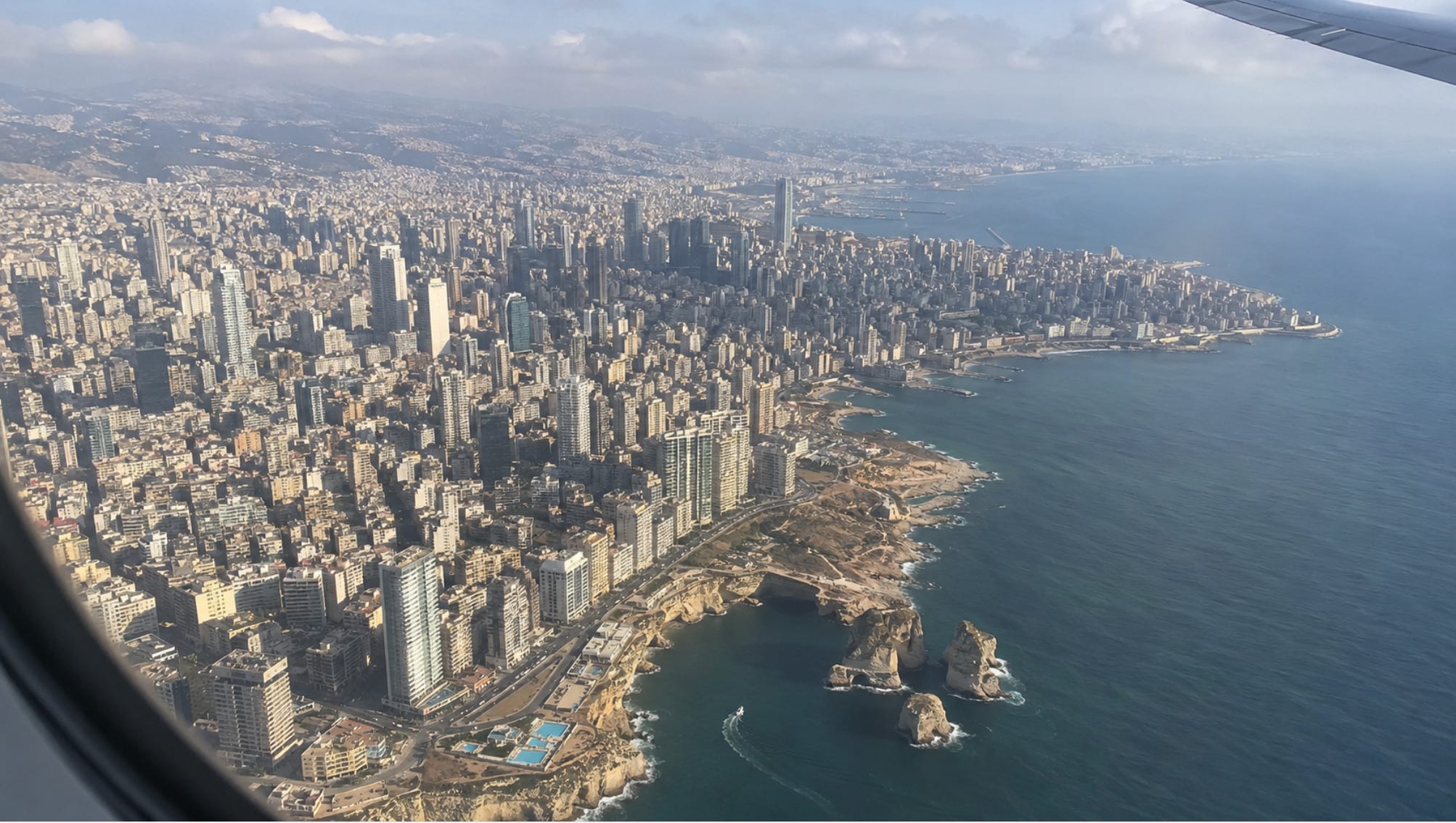
Beirut is one of the oldest continuously inhabited urban sites on the eastern Mediterranean, but its history is not the history of a city that was always great. For much of antiquity it stood in the shadow of older Phoenician ports such as Byblos, Sidon and Tyre. Its rise was irregular: modest in the Bronze and Iron Ages, transformed under Rome, damaged by earthquake, revived under Islamic and Crusader rule, and then remade in the 19th century as the commercial, educational and journalistic capital of Ottoman Syria. In the 20th century it became the capital of the Lebanese Republic, the “Paris of the Middle East,” a civil-war battlefield, a postwar reconstruction project, and finally a wounded but still culturally powerful city after the financial collapse of 2019 and the port explosion of 4 August 2020.
The name itself points to the city’s ancient geography. Beirut appears in ancient sources as Beruta or Berytus, probably deriving from a Semitic root connected with “wells.” A Canaanite town called Beruta appears in Bronze Age correspondence, including the Amarna letters of the 14th century BC and Ugaritic texts of the 13th century BC. At that stage, Beirut seems to have been dependent on Byblos, only about 30 km to the north. Archaeology supports the impression of deep continuity: studies of Beirut’s tell and city center point to roughly 5,000 years of human occupation spanning the Bronze Age, Iron Age, Persian, Seleucid, Roman and Byzantine periods.
The earliest Beirut was not a great imperial city. It was a coastal settlement with access to a protected harbor, fresh water and a hinterland rising toward Mount Lebanon. In the Bronze Age, the great cities of the Levantine coast were maritime nodes tied to Egypt, Cyprus, Anatolia and Mesopotamia. Beirut participated in that world, but it was not its center. Byblos had deeper Egyptian ties; Sidon and Tyre became the great Phoenician names of the Iron Age. Beirut’s significance was more local, lying in its position between sea and mountain, and in the small but valuable port that allowed it to serve nearby settlements and regional trade.
Under Assyrian, Babylonian and Persian rule, Beirut shared the fate of the wider Phoenician coast. The Phoenician cities were not a unified nation-state in the modern sense; they were maritime city-states, commercial communities and imperial clients. Beirut’s political status shifted with that of Sidon and the other coastal towns. It was drawn into the Assyrian imperial economy after the 9th century BC, passed through Babylonian and Achaemenid Persian phases, and then entered the Hellenistic world after Alexander the Great’s conquest of the Levant in the late 4th century BC.
The Hellenistic period gave Beirut a more distinct urban identity. It lay within the Seleucid sphere and was affected by the dynastic wars that repeatedly battered the region. Around 140 BC, the city was reportedly destroyed during the conflict involving Diodotus Tryphon and Antiochus VII Sidetes. It was then rebuilt on a more regular Hellenistic plan and was sometimes associated with the name Laodicea in Phoenicia. This is one of the first major turning points in Beirut’s urban history: the old Phoenician settlement gave way to a more planned Greco-Syrian city, with the civic institutions and symbolic language of the Hellenistic eastern Mediterranean.
Rome changed Beirut more profoundly than any previous empire. The city allied itself with Roman power and benefited from that choice. Pompey used Berytus as a naval base in his campaign against the Cilician pirates, and under Augustus the city became a Roman colonia with the formal name Colonia Julia Augusta Felix Berytus. This was not just a change of title. A colonia was a privileged Roman settlement whose citizens enjoyed Roman status. The Roman colonial foundation of Beirut under Augustus around 15 or 14 BCE, most likely as part of the Augustan reorganization of the eastern Mediterranean after the civil wars. The city was settled with Roman veterans, especially from Legio V Macedonica and Legio VIII Augusta. There may have been an earlier allocation of land under Mark Antony to veterans of V Alaudae, but the principal transformation of Berytus into a Roman veteran colony belongs to the Augustan period, around 15–14 BCE.
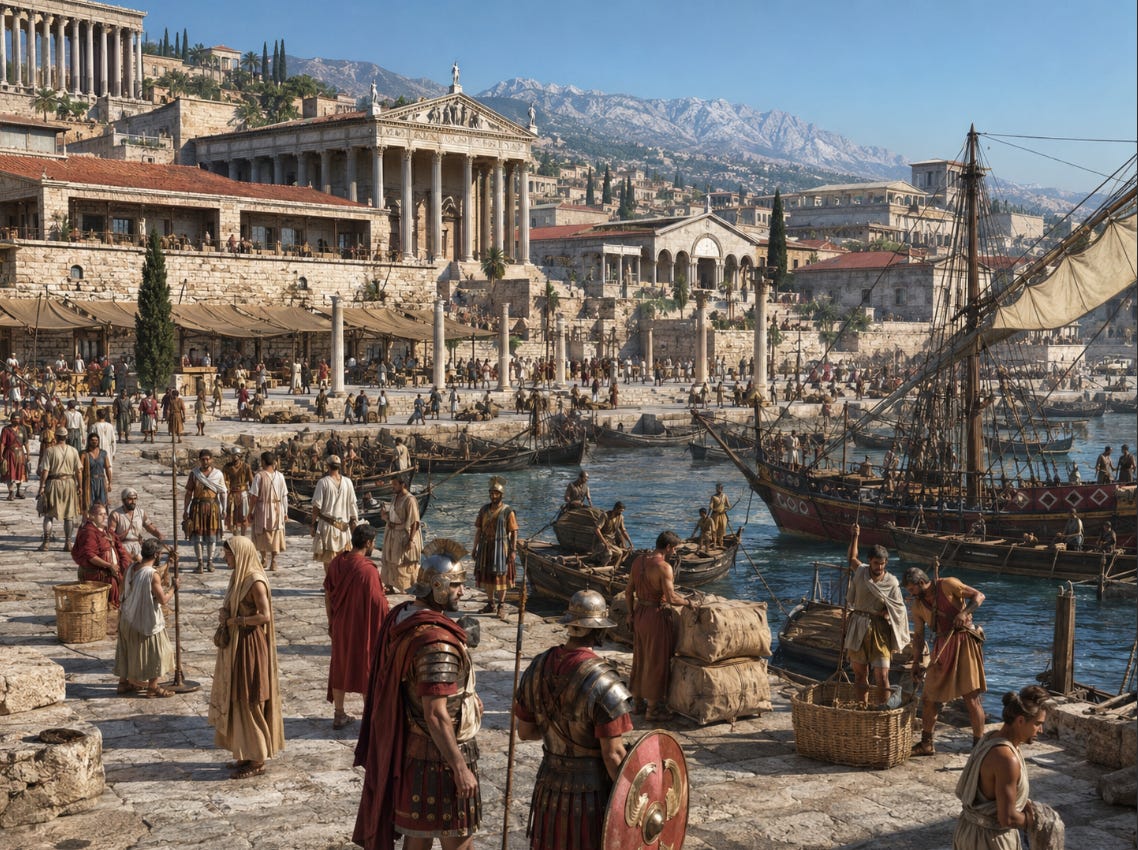
The settlement of Roman legionnaires is central to Beirut’s ancient history. Augustus used veteran colonies to reward soldiers, secure territory and Romanize strategic locations. In Berytus, discharged soldiers and their descendants formed a Latin-speaking colonial elite. The city’s territory was unusually large: it extended beyond the coastal settlement into parts of the Lebanon range and the Bekaa, including areas connected to Baalbek-Heliopolis. In effect, Roman Berytus was not merely a coastal town; it was the administrative and landholding center of a wide colonial district. Veteran settlement helped bring Roman law, land tenure, municipal institutions, Latin inscriptions and imperial culture into a deeply Semitic and Hellenistic region.
Roman Beirut was physically impressive. Archaeology and ancient references point to baths, an aqueduct, a colonnaded street, temples, a hippodrome and public monuments. Herod the Great and his dynasty patronized the city. The urban landscape was meant to make power visible: the colony presented itself as Roman, loyal and prosperous. In the eastern Mediterranean, where Greek remained the prestige language of many cities, Berytus was unusual for the strength of its Latin imprint. That Latin identity later mattered because it helped make the city a center of Roman legal education.
Between the 3rd and 6th centuries AD, Beirut became famous for its law school. Its reputation was so great that it acquired the title Berytus Nutrix Legum, “Berytus, mother of laws.” This was one of Beirut’s greatest historical moments: long before it was a capital of journalism, banking or nightlife, it was an intellectual capital of Roman jurisprudence.
The law school’s importance lay in its function. The Roman Empire needed trained jurists, administrators and legal scholars. Beirut supplied them, especially for the eastern provinces. Its law school linked provincial Phoenicia to the imperial centers of Rome and Constantinople. Students came to Beirut to study the legal tradition that would later shape Byzantine law, canon law and European civil law. The city’s identity as a place of education has therefore ancient roots, not merely 19th-century missionary origins.
But late antique Beirut was vulnerable. The city suffered from earthquakes, and the most devastating was the earthquake and tsunami of 551 AD. This disaster badly damaged the city and crippled the law school. Some accounts portray the earthquake as a near-total destruction; modern scholarship is more cautious, suggesting that the city was damaged and diminished rather than simply erased. Still, the event ended Beirut’s late antique golden age. When Muslim Arab forces entered the Levant in the 7th century, Beirut was no longer the great Roman legal metropolis it had once been.
Under early Islamic rule, Beirut became part of the coastal defense system of the caliphates. The Arab conquest of the Levant in the 630s shifted the city from the Byzantine to the Islamic world. Beirut was important, but not central. Damascus became the Umayyad capital; later Baghdad dominated the Abbasid world. Beirut’s value lay in its harbor and its role in defending the coast against Byzantine naval raids. The city’s population gradually Arabized and Islamized, though Christian communities remained present. Over time, Beirut became one of the fortified ports of the Syrian coast, linked to Damascus and the mountain hinterland.
The medieval city lived through cycles of contest. During the Crusades, Beirut became part of the Latin Kingdom of Jerusalem and later the lordship system of the Crusader coast. It was captured, fortified and incorporated into the commercial world of the Franks, Italian merchants and Levantine Christians and Muslims. Its position between Tripoli, Sidon and Acre made it strategically useful. But as in earlier periods, Beirut was often overshadowed by larger or more militarily significant cities.
The Mamluks retook Beirut in the late 13th century as part of their dismantling of Crusader power along the Levantine coast. Under Mamluk rule, many coastal cities were deliberately limited or controlled to prevent a renewed Frankish foothold. Beirut survived, but it did not become a major Mamluk metropolis. Its harbor, markets, mosques, churches and local notable families sustained urban life, but the main political and military centers were elsewhere. This relatively modest medieval status is important: Beirut’s modern rise was not inevitable. It was a product of later economic and geopolitical changes.
Ottoman rule began in the early 16th century after the Ottoman defeat of the Mamluks. For several centuries Beirut remained a small but useful port within the Ottoman Syrian system. It was connected to the Druze and Maronite mountain districts, to Damascus, and to the commercial routes of the eastern Mediterranean. Local notables, religious communities, merchants and consular agents gradually became more important. The city’s Sunni Muslim families were tied to Ottoman administration, commerce, religious institutions and municipal life. Greek Orthodox and Greek Catholic Christian families were prominent in trade, education, diplomacy and mediation between Europe and the Ottoman interior.
The 19th century transformed Beirut. This was the period in which the modern city was born. Several forces converged: the Tanzimat reforms of the Ottoman Empire, European commercial penetration, the growth of the silk economy in Mount Lebanon, missionary education, steamship routes, consular expansion and the increasing importance of Beirut as the port of Damascus. One modern study of Ottoman Beirut describes the city’s rise from a local market city into a transit city for the re-export of European commodities. It also notes the transformation from a walled town of narrow streets into a modern commercial center connected to the port and hinterland.
Beirut became the hinge between Mount Lebanon, Damascus and Europe. Raw silk from Mount Lebanon went through Beirut to France; European manufactured goods came in through Beirut and moved inland. The Beirut-Damascus axis became one of the major commercial corridors of the eastern Mediterranean. An open-access historical chapter on Beirut’s rise between 1820 and 1918 describes the city as benefiting from late Ottoman modernization and European capital, and notes that the Beirut-Damascus axis became the main avenue of international trade in the eastern Mediterranean. In 1887, the Ottoman authorities recognized Beirut’s importance by making it the capital of a new vilayet bearing its name.
The population grew rapidly. Beirut moved from a relatively small Ottoman town into a Levantine city of merchants, journalists, missionaries, bankers, teachers, translators and political activists. Foreign consulates multiplied. European banks and shipping firms arrived. Printing presses, newspapers and schools gave Beirut an intellectual influence disproportionate to its size. The American Syrian Protestant College, later the American University of Beirut, opened its first class in 1866, while Saint Joseph University was established by the Jesuits in 1875. These institutions trained generations of Arab intellectuals, doctors, lawyers, journalists and politicians.
This 19th-century Beirut also produced a new elite. The old Muslim notable families remained important, especially among the Sunni urban population. At the same time, Christian merchant families, particularly Greek Orthodox and Greek Catholic families, acquired major influence through trade, education and foreign connections. The Sursock family is perhaps the most famous example. Lorenzo Trombetta’s study of the Sursuq/Sursock archive describes the family as one of the most illustrious Beirut families of Christian notables and emphasizes the role of Greek Orthodox notables in Beirut from the mid-19th century.
The sectarian breakdown of Beirut’s famous families must be handled carefully. Lebanese families are not just private kin groups; many are political, commercial and confessional institutions. Sect often shaped marriage networks, education, patronage, parliamentary seats, charitable institutions and neighborhood geography. But families also intermarried, migrated and changed roles over time. Beirut’s elites were more cosmopolitan than a simple sectarian map suggests.
Among the old Sunni Muslim Beiruti families, the Salam family was one of the most important. Salim Ali Salam was a major late Ottoman Sunni figure, merchant, mayor of Beirut and Ottoman parliamentarian; his descendants included Saeb Salam and Tammam Salam, both prime ministers of Lebanon. The Daouk family, associated with Ras Beirut, produced Ottoman and Lebanese public figures including Omar Daouk and Ahmad Daouk. Other Sunni Beiruti families often associated with the city’s old Muslim notable class include Itani, Sinno, Mneimneh, Kreidieh, Yafi, Bayhum, Hoss and others. The Yafi family produced Abdallah El-Yafi, a repeated prime minister of Lebanon; the Hoss family produced Salim al-Hoss, another prime minister identified with Beiruti Sunni politics.
The Solh family was also central to Sunni Lebanese politics, though its roots are often associated with Sidon as well as Beirut. Riad al-Solh, Lebanon’s first prime minister after independence, was one of the architects of the 1943 National Pact. The Solh family’s prominence shows that Beirut’s political class was never purely local; it drew in Sidonian, Tripolitan, Damascene, mountain and diaspora families whose fortunes became tied to the capital.
Among the Greek Orthodox families, the most famous were the so-called “Seven Families” of the old Beirut Christian aristocracy: Sursock, Bustros, Tueni, Trad, Fayad, Ferneini and Araman. They were associated with commerce, diplomacy, landholding, journalism, philanthropy and high society. The Sursocks became symbols of Ottoman and Mandate-era wealth, with palaces, archives, landholdings and international marriages. The Bustros family gave its name to streets and institutions and produced major cultural and political figures. The Tueni family became famous through journalism, especially An-Nahar, founded by Gebran Tueni and later associated with Ghassan Tueni and Gebran Tueni the younger. These families were not merely religious communities; they were urban brokers between the Ottoman state, European consuls, local society and the emerging Lebanese public sphere.
The Greek Catholic, or Melkite, community also produced important Beirut families. The Pharaon family, prominent in commerce and politics, is usually described as Melkite Greek Catholic. Henri Pharaon was one of the major figures of Lebanese independence and one of the wealthiest men in mid-20th-century Lebanon. The Chiha family, also associated with the Greek Catholic milieu, produced Michel Chiha, the banker, journalist and political thinker whose ideas helped shape the Lebanese constitutional and economic model. Beirut’s Greek Catholics occupied an intermediate position: Arab, Catholic, urban, commercially active and often strongly Francophone.
Maronite families became increasingly important in Beirut as migration from Mount Lebanon expanded in the 19th and 20th centuries. Strictly speaking, many of Lebanon’s great Maronite political families were not originally Beiruti: the Gemayels came from Bikfaya, the Chamouns from Deir al-Qamar, the Frangiehs from Zgharta, and the Edde family from the Byblos region. But Beirut, especially Ashrafieh and later East Beirut, became the main urban stage for Maronite political, commercial and cultural power. Maronite influence in Beirut expanded through schools, printing, professional life, party organization and state institutions.
Armenian families form another essential layer of Beirut’s modern history. After the Armenian genocide, survivors settled in Beirut and its environs, especially in neighborhoods such as Bourj Hammoud, Mar Mikhael, Rmeil and Medawar. Armenian Orthodox and Armenian Catholic communities became deeply embedded in the city’s craft, commercial, political and cultural life. The Lebanese Center for Policy Studies notes the high confessional fragmentation of Beirut I, where Armenian Orthodox voters formed the largest registered group in that district in 2018, followed by Greek Orthodox, Maronites, Christian minorities, Greek Catholics, Sunnis, Armenian Catholics and Shias.
The Shia presence in Beirut expanded dramatically in the 20th century, especially through migration from southern Lebanon and the Bekaa. Historically, Beirut’s Shia were fewer and less politically dominant than Sunnis and Christians. But rural poverty, state neglect, Israeli conflict in the south and the growth of suburbs transformed the city’s demography. The southern suburbs, especially Dahiyeh, became a major Shia urban zone. Families from Jabal Amel, Baalbek-Hermel and the Bekaa settled in and around Beirut, creating new social and political realities. By the late 20th century, Shia parties, especially Amal and Hezbollah, had become central to Beirut’s balance of power.
The French Mandate after World War I turned Beirut from an Ottoman provincial capital into the capital of Greater Lebanon. In 1920, the French proclaimed the State of Greater Lebanon, attaching Beirut to Mount Lebanon, Tripoli, Sidon, Tyre, the Bekaa and other territories. This was a decisive act. Beirut became the capital of a new political entity whose communities had different historical orientations: Maronite mountain notables, Sunni coastal elites, Shia rural populations, Druze mountain families, Greek Orthodox merchants, Greek Catholics, Armenians and others. The Lebanese state was built around compromise, but also around communal arithmetic.
Independence in 1943 confirmed Beirut’s role as the center of Lebanese politics. The National Pact gave the presidency to a Maronite, the premiership to a Sunni, and the speakership of parliament to a Shia. This arrangement reflected the demographic and political assumptions of the time. Beirut benefited from the postwar regional order. It became a banking center, a press capital, a university city, a port, a tourism hub and a refuge for exiles, spies, writers, businessmen and dissidents. It was Arab and Mediterranean, French-speaking and Arabic-speaking, capitalist and literary, conservative and bohemian.
The city’s neighborhoods reflected its pluralism. Ras Beirut and Hamra became associated with universities, cafes, newspapers and Arab intellectual life. Downtown Beirut remained the commercial heart. Ashrafieh and Gemmayzeh were important Christian quarters. Basta, Mazraa and Tariq al-Jadideh were associated with Sunni urban life. Zokak el-Blat carried layers of Ottoman, educational and political history. Bourj Hammoud became a center of Armenian life. The southern suburbs absorbed poorer migrants and later became a stronghold of Shia political mobilization.
The civil war of 1975-1990 shattered this world. Beirut became divided between a largely Christian east and a largely Muslim west, though the reality was more complicated than the shorthand suggests. The Green Line cut through the city center. Militias replaced the state; neighborhoods became militarized; foreign armies and intelligence services operated openly or covertly. The Palestinian armed presence, Israeli invasions, Syrian intervention, Lebanese militia rivalries, sectarian massacres and economic collapse all converged in Beirut. The downtown area of central Beirut was destroyed during the civil war and became a belt of ruins between East and West Beirut.
The war altered Beirut’s families and sectarian geography. Old Sunni notable families lost some ground to armed movements and later to the Hariri political-economic machine. Christian families were displaced from West Beirut; Muslim families were displaced from East Beirut. The Greek Orthodox and Greek Catholic commercial elites lost some of their old cosmopolitan centrality. Shia migrants and parties became more influential. The war did not invent sectarian identity in Beirut, but it hardened it into territorial form.
Postwar Beirut was reconstructed under the influence of Prime Minister Rafic Hariri and the company Solidere. The downtown was cleared and rebuilt as a polished commercial district of restored facades, luxury real estate, reconstructed streets and archaeological fragments. Supporters saw this as a necessary revival of the city center; critics saw it as privatized memory, a replacement of the old mixed city with an expensive simulacrum. Either way, the reconstruction confirmed an old truth: whoever controls central Beirut controls the symbolic heart of Lebanon.
The postwar period also produced new contradictions. Beirut regained restaurants, universities, banks, festivals and nightlife. It attracted tourists and diaspora money. But the economy relied heavily on debt, real estate, banking inflows and political patronage. The state remained weak, sectarian leaders remained powerful, and Hezbollah’s armed role created a duality between state and non-state power. The 2005 assassination of Rafic Hariri in Beirut triggered the Cedar Revolution, Syrian withdrawal and a new political polarization between March 14 and March 8 forces. The 2006 war between Israel and Hezbollah again damaged parts of the city, especially the southern suburbs.
The crisis that began in 2019 was different because it struck the whole model. Lebanon’s banking system collapsed; depositors were locked out of savings; the currency lost most of its value; poverty expanded; state services deteriorated. The World Bank describes the post-2019 crisis as the most severe economic and financial collapse in Lebanon’s history, leaving the banking sector insolvent and causing the Lebanese pound to lose 98% of its value.
Then came the port explosion of the 4th of August 2020. A massive blast destroyed much of the port and severely damaged dense residential and commercial areas within five kilometers. The World Bank’s damage assessment states that the explosion left more than 200 dead, thousands injured and many homeless. It was not just a physical disaster; it was a moral and political rupture. Beirutis saw in the blast the accumulated negligence of the state: corruption, impunity, administrative decay and contempt for ordinary life.
Modern Beirut remains unfinished. It is still a capital of culture, education, medicine, publishing, cuisine and memory. It is still the city of AUB and USJ, of Hamra and Ashrafieh, of the Corniche and the port, of mosques beside churches, of Armenian workshops and Shia suburbs, of Sunni notable houses and Greek Orthodox palaces. But it is also a city of broken banks, damaged neighborhoods, emigration, political paralysis and periodic war scares.
Beirut’s long history shows a repeated pattern. It rises when it connects worlds: sea and mountain, Rome and Phoenicia, Damascus and Europe, Arab politics and Mediterranean commerce, education and journalism, capital and diaspora. It declines when those connections become militarized, monopolized or destroyed. Roman Berytus flourished because it became a colony, legal center and imperial node. Ottoman Beirut flourished because it became the port of Damascus and the hinge of the silk economy. Modern Beirut flourished because it mediated between the Arab world, Europe, finance, education and culture.
Its tragedy is that the same openness made it vulnerable. Empires wanted it, merchants exploited it, armies crossed it, sectarian leaders divided it, and foreign powers used it as a stage. But its resilience is real. Few cities have been Phoenician settlement, Roman colony, Byzantine law school, Islamic port, Crusader lordship, Mamluk town, Ottoman provincial capital, French Mandate capital, Arab banking center, civil-war ruin and post-blast symbol of civic anger. Beirut is not only a city with a history; it is a city made of historical layers that remain visible in its stones, families, neighborhoods and political wounds.
The famous families of Beirut are part of that layered story. Sunni families such as Salam, Daouk, Yafi, Hoss, Itani, Sinno and Mneimneh speak to the old Muslim city of merchants, mayors, jurists and prime ministers. Greek Orthodox families such as Sursock, Bustros and Tueni speak to the 19th-century merchant aristocracy and the world of journalism, diplomacy and landholding. Greek Catholic families such as Pharaon and Chiha speak to the Francophone, commercial and constitutional imagination of modern Lebanon. Maronite families, many originally from Mount Lebanon rather than Beirut itself, made the capital their political stage. Armenian families rebuilt lives in the city after catastrophe and became one of its most industrious communities. Shia families from the south and Bekaa reshaped the metropolitan edge and became central to the politics of modern Beirut.
To write Beirut’s history, therefore, is not to write the story of one people. It is to write the story of a port that repeatedly absorbed outsiders and turned them into Beirutis. The city’s greatness has always come from mixture.